
He established the Department of Physics in 1949 with the establishment of the College of Science at the University of Baghdad. Over the course of sixty years,
the Department of Physics was the inexhaustible, generous and inexhaustible resource in the dissemination of science and the solution of many scientific dilemmas. World-renowned scientists.
The generations graduating from the Department of Physics have inherited the torch of giving, illuminating the path of science for future generations and preserving their scientific, cultural and heritage heritage of the Physics Department, which is characterized by the existence of a lifestyle, customs and traditions that differ from the rest of the departments in the college or the usual contexts in different departments and universities, where The atmosphere of one family with its many generations prevails within the interactions and dealings between the members of the department.
The Department of Physics is characterise by keeping pace with scientific progress and the latest scientific news in the whole world, as it holds many discussions, seminars and conferences that deal with all the latest developments in the broad physical sciences, not to mention the rest of science and other fields of culture to become a rich source of physical sciences and general culture.
Over the years, the Department of Physics has developed a lot in many respects, scientifically, technically and administratively, and it is always in a state of continuous renewal, as graduate studies were opened in 1956 for masters and doctorate until it has become broad-spectrum now and has a solid scientific position and has also expanded in the various fields of physical scientific research until there is no room left even if It was accurate, but the physics department has a long history and a great impact on it.
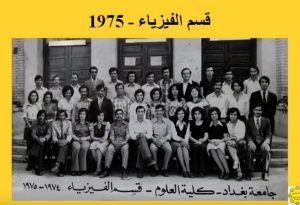
The Department of Physics, with all its teaching, aspires to be better and more distinguished scientifically and culturally at the global level to rise to the levels of advanced international universities. Given the progress of physics and its wide spectrum, the department aspires to turn into a College of Physics and Astronomy that includes many of the precise scientific disciplines required for the development of the country and the advancement of the scientific and technological level. And the cultural center towards a bright future, especially since it possesses all the scientific capabilities and human resources necessary to establish a distinguished College of Physics and Astronomy, thus being the first at the level of Iraq, the Arab countries and the Middle East at the level of its counterparts in advanced universities worldwide.
As a result of the development in physics and its wide spectrum, since the beginning of graduate studies, research groups have been formed in the department that have developed over time to become as follows:
-
- Thin-film physics and superconductivity.
- Electro-optics physics and nanotechnology.
- Laser and molecular physics and renewable energies.
- Plasma physics and technology.
- Nuclear and Environmental Physics.
- Material Physics.
- The remote sensing group which then became a separate unit.
The Department of Physics, since its establishment in 1949, has been headed by many of the first pioneering professors, as shown below:
1- Professor Kenzi (English) ———– (1949 – 1956)
2- Prof. Abdul-Jabbar Abdullah————————– (1956)
3- Prof. Salah Tahseen————————- (1956-1958)
4- Prof. Jassim Muhammad Al-Husseini————–( 1958-1962)
5- Prof. Mahmoud Kanona———————— (1962-1967)
6- Prof. Jassim Muhammad Al-Husseini —————( 1967-1969)
7- A. Dr.. Abbas Al-Hassoun———————-(1969-1970)
8- Prof. Abdel Rahim Abdel Katal —————- (1970-1973)
9- Prof. Abdul-Amir Abdul-Karim Al-Qazzaz ———(1973-1975)
10- Prof. Ali Attia Abdullah—————- (1975-1981)
11- Prof. Abdul-Amir Abdul-Karim Al-Qazzaz ——– (1981-1987)
12- Prof. Ali Attia Abdullah ————— (1987-1989)
13- a. Dr.. Razak Hamid Youssef —————–( 198-1992 )
14- Prof. Hamid Majoul Al-Nuaimi ————-( 1992-1994 )
15- – Prof. Dr. Abdul-Amir Abdul-Karim Al-Qazzaz ——-(1994-1997)
16- a. Dr.. Razak Hamid Youssef ————– (1997-2003)
17- Prof. Bahaa Tohme Giad —————— (2003-2004)
18- Prof. Raad Abdul Karim Radi ———–(2004-2006)
19- Prof. Bahaa Tohme Giad —————–( 2007- 2011)
20- Prof. Raad Abdul Karim Radi —————– (2011)
21- a. Dr.. Raad Muhammad Saleh Al-Haddad ——-( 2011 – 2014)
22- Prof. Raad Abdul Karim Radi ——— (2014 – 2017)
23- Asia Hamid Hamad ——————– (2017 – 2018)
24- Prof. Dr. Ali Abdel Latif Karim ——–(2018- until now)
The department pays special attention to pure and applied scientific studies to qualify students theoretically and practically and enable them to continue their higher studies on the one hand and to play a distinguished role in research, development and work in scientific and industrial institutions related to physics.
-
- Laboratories of the Ministry of Industry.
- Ministry of Health laboratories.
- Technical formations in the Ministries of Interior and Defense.
- Technical facilities at the Ministry of Communications and the Ministry of Communications.
- Laboratories and facilities of the Ministry of Oil.
- Standardization and quality control laboratories.
- Technical installations of the Ministry of Housing and Construction.
- Ministry of Electricity facilities.
- Laboratories and facilities of the Ministry of Environment.
- Laboratories of the Ministry of Irrigation and Water Resources.
- Research centers of the Ministry of Science and Technology.