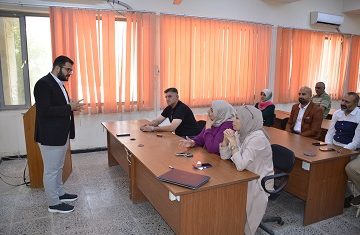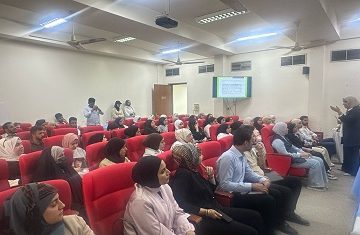

From the Mathematics Community of Baghdad to the Frontiers of Abstract Thinking: What if the distance from a point to itself were not zero? This seemingly paradoxical question lies at the heart of partial metric spaces, a mathematical framework introduced by Stephen G. Matthews in 1992 and developed in his landmark 1994 publication. Unlike conventional metric spaces, partial metric spaces permit nonzero self-distances while preserving carefully modified principles of symmetry, separation and the triangle inequality. A striking example is the function p(x, y) = max{x, y} on the non-negative real numbers, where p(x, x) = x may be positive. This generalisation generates T₀ topological structures and provides a framework for studying convergence, completeness and fixed-point theory. Its significance extends to theoretical computer science, particularly denotational semantics, where partially defined computational objects require mathematical models that can express incomplete information. Although certain fixed-point results in partial metric spaces can be derived from classical metric theory, the framework remains valuable for exploring relationships among distance, topology, order, and computation. For the next generation of mathematicians, the challenge is clear: think beyond the familiar, question the axioms and discover what lies beyond zero. https://www.linkedin.com/feed/